

Aluminum Die Casting Surface Polishing: The Complete Guide to ADC12 Mirror Finishing, Cost Factors, and Clear Coat Selection
September 22, 2026
Aluminum Die Casting Surface Polishing: The Complete Guide to ADC12 Mirror Finishing, Cost Factors, and Clear Coat Selection
The surface finish of an aluminum die-cast part affects far more than just its visual appeal. It also impacts dimensional accuracy, weather resistance, production yield, and overall manufacturing cost. This is especially true for ADC12 aluminum die castings, where achieving a near-mirror, high-gloss finish requires multiple stages of sanding, precision polishing, cleaning, and anti-oxidation treatment.
Most RFQs request "aluminum polishing" without specifying surface roughness, gloss levels, or acceptance criteria — a gap that frequently leads to costly misunderstandings between engineering expectations and shop-floor reality. If your product demands an uncompromising aesthetic appearance, confirm the following before tooling is made. Understanding the full mirror-polishing workflow, common defects, and cost drivers behind aluminum die casting finishing will save both time and budget.
Table of Contents
- What Is Aluminum Die Casting Surface Polishing?
- Is ADC12 Suitable for Mirror Polishing?
- The Aluminum Die Casting Mirror Polishing Process
- Common Defects in Mirror-Polished Die Castings
- Polishing Compound Residue and Cleaning Methods
- Clear Coat or Bare Metal After Polishing?
- How to Define Surface Roughness and Appearance Standards
- What Drives the Cost of Aluminum Die Casting Polishing?
- How to Reduce Mirror Polishing Costs
- What Information to Provide Before Requesting a Polishing Quote
- Frequently Asked Questions (FAQ)
1. What Is Aluminum Die Casting Surface Polishing?
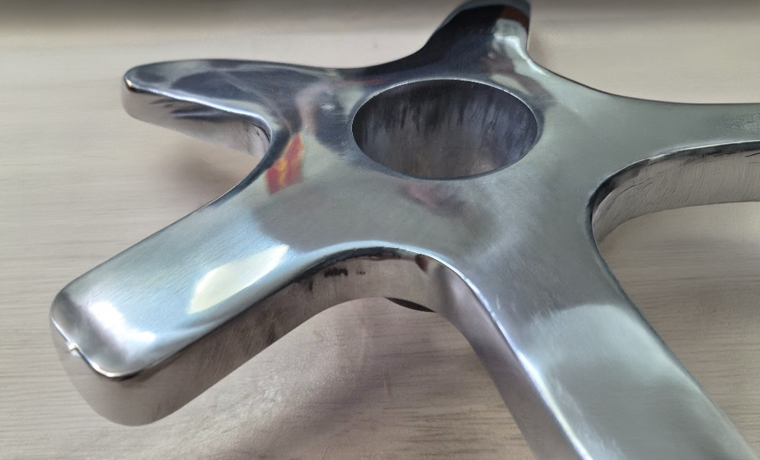
Aluminum die casting surface polishing is a finishing process that uses sandpaper, abrasive belts, polishing wheels, and specialized polishing compounds to progressively remove flash, parting lines, oxide skin, flow marks, and fine scratches — leaving the casting with a smooth, high-gloss metallic surface.
Polishing, however, is not simply "making the surface shiny." If the die-cast part already contains porosity, shrinkage voids, cold shuts, or deep flow lines, aggressive sanding can actually expose those internal defects — or even cause dimensional deviation. Before committing to a mirror-finish specification, manufacturers should evaluate:
- The aluminum alloy grade and overall casting quality
- The extent of porosity, shrinkage, and flow marks
- Which surfaces are cosmetic ("Class A") and which are non-visible
- Available stock allowance for material removal during polishing
- The location of parting lines, ejector pin marks, and gate positions
- Whether a clear coat or other post-finish treatment will be applied
2. Is ADC12 Suitable for Mirror Polishing?
ADC12 offers excellent fluidity, castability, and dimensional stability, making it a popular choice for automotive components, housings, heat sinks, motor enclosures, and consumer electronics.
However, ADC12's relatively high silicon content means the material can contain eutectic silicon phases and micro-porosity. As a result, even after fine sanding and polishing, ADC12 may not achieve the same uniform mirror clarity as stainless steel, high-purity aluminum, or forged aluminum alloys.
For products with demanding cosmetic requirements, confirm the following before tooling:
- Whether ADC12 can realistically meet the intended appearance standard
- Whether mold venting and casting density are sufficient to minimize porosity
- Whether cosmetic surfaces can be positioned away from ejector pins, parting lines, and gates
- Whether adequate stock allowance has been designed in for polishing
- Whether an alternative aluminum alloy better suited to high-gloss finishing should be considered
In short: "ADC12 can be polished" does not mean every ADC12 casting will consistently achieve a flawless mirror finish. The outcome depends heavily on part geometry and casting quality.
3. The Aluminum Die Casting Mirror Polishing Process
Step 1: Visual Inspection and Pre-Processing
Before polishing begins, parts are inspected for flash, gate remnants, parting lines, ejector pin marks, scratches, porosity, shrinkage, and flow marks. Deburring, gate trimming, and localized leveling follow.
If a casting shows significant porosity or cold shut defects at this stage, it's worth evaluating whether the part is even worth advancing to the labor-intensive polishing stages — rather than discovering the defect after hours of finishing work have already been invested.
Step 2: Progressive Coarse-to-Fine Sanding
A typical grit progression looks like this:
- #80, #120 — Remove flash, gate marks, and obvious surface defects
- #200, #320 — Level the surface and reduce deep scratches
- #400, #600 — Establish a uniform sanding pattern
- #800, #1000 — Advanced fine sanding
- #1200 to #2000 — Additional refinement depending on the target finish
Each grit stage must fully remove the scratch pattern left by the previous stage. Skipping grits too aggressively often leaves fine scratches, haze, or uneven reflectivity that only becomes visible once true polishing begins.
Pressure and direction must also be carefully controlled throughout sanding to avoid localized pitting, rounded edges, thinned walls, or dimensional deviation.
Step 3: Polishing Wheel and Compound Application
Once fine sanding is complete, cotton, cloth, or wool polishing wheels — paired with aluminum-specific polishing compounds — are used in three sub-stages:
- Rough polishing — Eliminates residual fine sanding marks
- Medium polishing — Improves brightness and uniformity
- Fine polishing — Produces the final high-reflectivity mirror surface
Wheel speed, contact pressure, compound quantity, and dwell time must all be tightly controlled. Excessive pressure can cause localized overheating, surface deformation, or compound buildup.
Step 4: Cleaning and Quality Inspection
After polishing, parts undergo degreasing, neutral detergent washing, ultrasonic cleaning, or high-pressure rinsing to remove polishing compound and metal fines. Inspection then checks for:
- Visible scratches or haze
- Uniformity of reflectivity across the surface
- Residual polishing compound or oil films
- Over-polished or rounded edges
- Any dimensional impact from material removal
4. Common Defects in Mirror-Polished Die Castings
Porosity and Shrinkage Voids
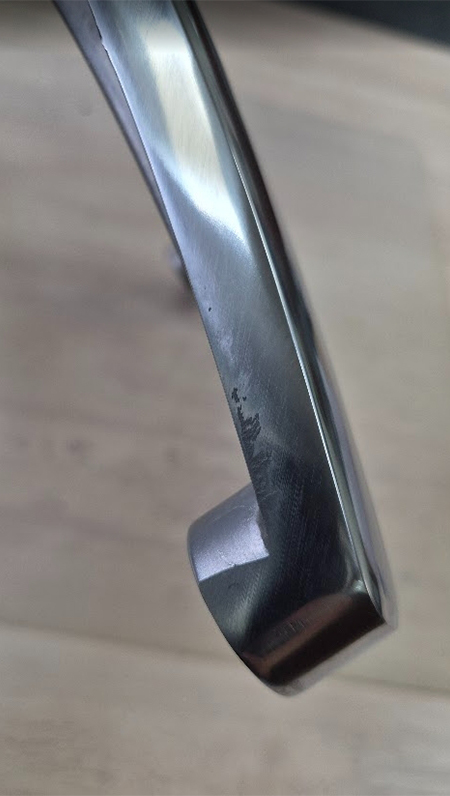
As sanding removes the outer skin of a casting, subsurface porosity can be exposed as pinholes, pits, or dark spots. Isolated defects may be addressed with localized repair, but widespread porosity points to a deeper issue requiring correction at the mold-venting, casting-parameter, or part-design level.
Parting Lines, Ejector Marks, and Flow Lines
If parting lines, ejector pins, or gates fall on cosmetic surfaces, traces may persist even after polishing. Where flow marks or cold shuts run deep, over-sanding to remove them risks creating localized wall-thickness deficiencies.
Orange Peel and Uneven Reflectivity
Insufficient flatness, an incorrect choice of polishing wheel, or uneven applied pressure can produce an "orange peel" texture, haze, or waviness. True mirror quality isn't just about gloss — it also requires consistent flatness and reflection uniformity across the entire surface.
5. Polishing Compound Residue and Cleaning Methods
Polishing compounds contain abrasive particles, oils, and waxes that readily lodge in deep holes, narrow slots, threads, corners, cooling-fin gaps, and micro-porosity on the surface.
Incomplete cleaning can lead to:
- Poor clear coat adhesion
- Blistering, bubbling, or peeling after painting/baking
- Uneven plating or anodizing
- Oily stains or a white haze on the finished surface
- Cross-contamination of other parts during assembly
For structurally complex die castings, multi-stage degreasing combined with ultrasonic cleaning is recommended. High-spec products may also require white-cloth wipe tests, surface tension testing, or coating adhesion verification.
6. Clear Coat or Bare Metal After Polishing?
Whether to apply a clear protective coating depends on the product's operating environment, cosmetic requirements, and expected maintenance regimen.
Bare Metal (No Clear Coat)
Pros:
- Preserves the aluminum's native luster and authentic metallic feel
- No added coating thickness
- Eliminates one process step and its associated cost
Cons:
- Prone to oxidation, discoloration, and visible fingerprints
- Limited scratch and chemical resistance
- Difficult to maintain appearance in high-humidity or salt-spray environments
Clear Protective Coating
Pros:
- Slows oxidation and discoloration
- Improves weather resistance and fingerprint resistance
- Reduces day-to-day cleaning and maintenance requirements
Cons:
- Can slightly dull the raw metallic shine
- Adds cost for cleaning, spraying, curing, and inspection
- Risk of orange peel, runs, particulate contamination, or poor adhesion
As a general rule: products intended for outdoor use, humid environments, or frequent hand contact typically benefit from a clear protective coating. Products where authentic metal texture matters most — and that will be used in stable environments — may be better served by leaving the polished surface uncoated.
7. How to Define Surface Roughness and Appearance Standards
Terms like "mirror finish," "high gloss," and "bright finish" are highly subjective and frequently interpreted differently by buyers and suppliers. To avoid disputes, drawings or specification sheets should explicitly state:
- Surface roughness requirements (e.g., Ra value)
- Gloss level and the measurement angle used
- Which surfaces are cosmetic, non-cosmetic, or masked
- Acceptable size and quantity of scratches, pits, and porosity
- Lighting source, viewing distance, duration, and angle for visual inspection
- Whether localized repair or minor color variation is acceptable
- Approved golden samples or appearance limit samples
Low surface roughness alone does not guarantee a visually convincing mirror effect. High-end cosmetic parts must simultaneously manage roughness, gloss, flatness, waviness, and surface defects as an integrated set of criteria.
8. What Drives the Cost of Aluminum Die Casting Polishing?
Mirror polishing costs go well beyond sandpaper and polishing compound. Labor hours, cleaning, inspection, and scrap risk are typically the dominant cost drivers.
Key quoting factors include:
- Part size and weight — Larger parts require more sanding time and fixturing
- Geometric complexity — Deep pockets, small holes, curved surfaces, sharp corners, and cooling fins depend heavily on manual labor
- Polished surface area — Localized polishing of cosmetic surfaces is generally more economical than full-part mirror finishing
- Raw casting quality — More porosity, shrinkage, and flow marks translate directly into more rework
- Target finish grade — Standard bright, high-gloss, and true mirror finishes each demand different process depth and inspection rigor
- Order quantity — Fixturing and setup costs are harder to amortize on small prototype runs
- Downstream processes — Clear coating, plating, PVD, or other coatings all add process steps and yield risk
For this reason, a quote should never simply say "polishing." It must clearly define the polished area, target appearance grade, and inspection specification.
9. How to Reduce Mirror Polishing Costs
If a product genuinely requires a high-end finish, appearance requirements should be baked into design and tooling decisions from the start:
- Position primary cosmetic surfaces where sanding access is easiest
- Route parting lines, ejector pins, and gates to non-cosmetic areas
- Avoid deep pockets, thin ribs, and sharp corners in mirror-finish zones
- Reserve adequate stock allowance in areas requiring polishing
- Use localized polishing rather than full-part mirror treatment
- Improve mold venting and casting parameters to reduce porosity and flow marks
- Build pre-production samples to validate appearance, cycle time, and acceptance criteria
- Replace vague "perfect mirror" language with approved limit samples
If the die-cast substrate simply isn't suited to mirror finishing, consider alternatives such as CNC machining, bead blasting, glass bead treatment, plating, PVD coating, or clear top-coating.
10. What Information to Provide Before Requesting a Polishing Quote
To get an accurate cost estimate for aluminum die casting polishing, provide your supplier with:
- 2D drawings, 3D models, and product photos
- The aluminum alloy grade (e.g., ADC12)
- Part dimensions, weight, and estimated order volume
- The specific surface areas requiring polishing
- Target finish level: mirror, high-gloss, or standard bright
- Surface roughness or gloss specifications
- Acceptance criteria for porosity, scratches, and color variation
- Whether localized repair is permitted
- Whether a clear protective coating is required
- Salt spray, alcohol resistance, or scratch resistance test requirements
- Standard samples or appearance limit samples
The more complete the specification, the more accurately a supplier can estimate labor, consumables, yield, and downstream processing costs — and the lower the risk of renegotiation or rework once production begins.
11. Frequently Asked Questions (FAQ)
Can ADC12 aluminum die castings achieve a true mirror finish?
Yes, but the result depends on material quality, casting density, porosity, part geometry, and appearance standards. If the substrate contains dense porosity or deep flow marks, a fully uniform mirror finish may not be achievable.
Will an ADC12 part oxidize after polishing?
Yes. Extended exposure to air, humidity, sweat, or contaminants can cause the surface to lose its shine or discolor. If long-term appearance retention is important, consider a clear protective coating or another anti-oxidation treatment.
Does polishing affect part dimensions?
Yes. Both sanding and polishing remove material, which can affect bore diameters, mating surfaces, flatness, and edge geometry. Critical dimensional areas should be explicitly flagged as "no-polish" zones or given a strict material-removal limit.
Can a clear coat be applied directly after polishing?
Not recommended. Polishing compound, oils, and metal fines must be thoroughly removed before coating — otherwise you risk pinholing, bubbling, peeling, or poor adhesion.
How can I reduce the cost of aluminum die casting mirror polishing?
Focus on improving raw casting quality, simplifying part geometry, minimizing the polished surface area, optimizing parting line placement, and clearly defining appearance standards upfront — this avoids both over-processing and repeated rework.
Conclusion: Define the Finish Before You Choose the Process
Aluminum die casting surface polishing is an integrated engineering discipline that spans material selection, tooling, casting, sanding, cleaning, and coating. While ADC12 is fully capable of high-gloss polishing, the achievable result ultimately depends on porosity, flow marks, part complexity, and how clearly the appearance standard has been defined.
The right time to lock down alloy selection, mirror-finish zones, sanding allowance, surface roughness targets, cleaning method, clear coat requirements, and expected production yield is at the very start of the project — not after tooling is cut. With validated samples and precise specifications in hand, manufacturers can strike the right balance between aesthetics, durability, production efficiency, and overall aluminum die casting polishing cost.